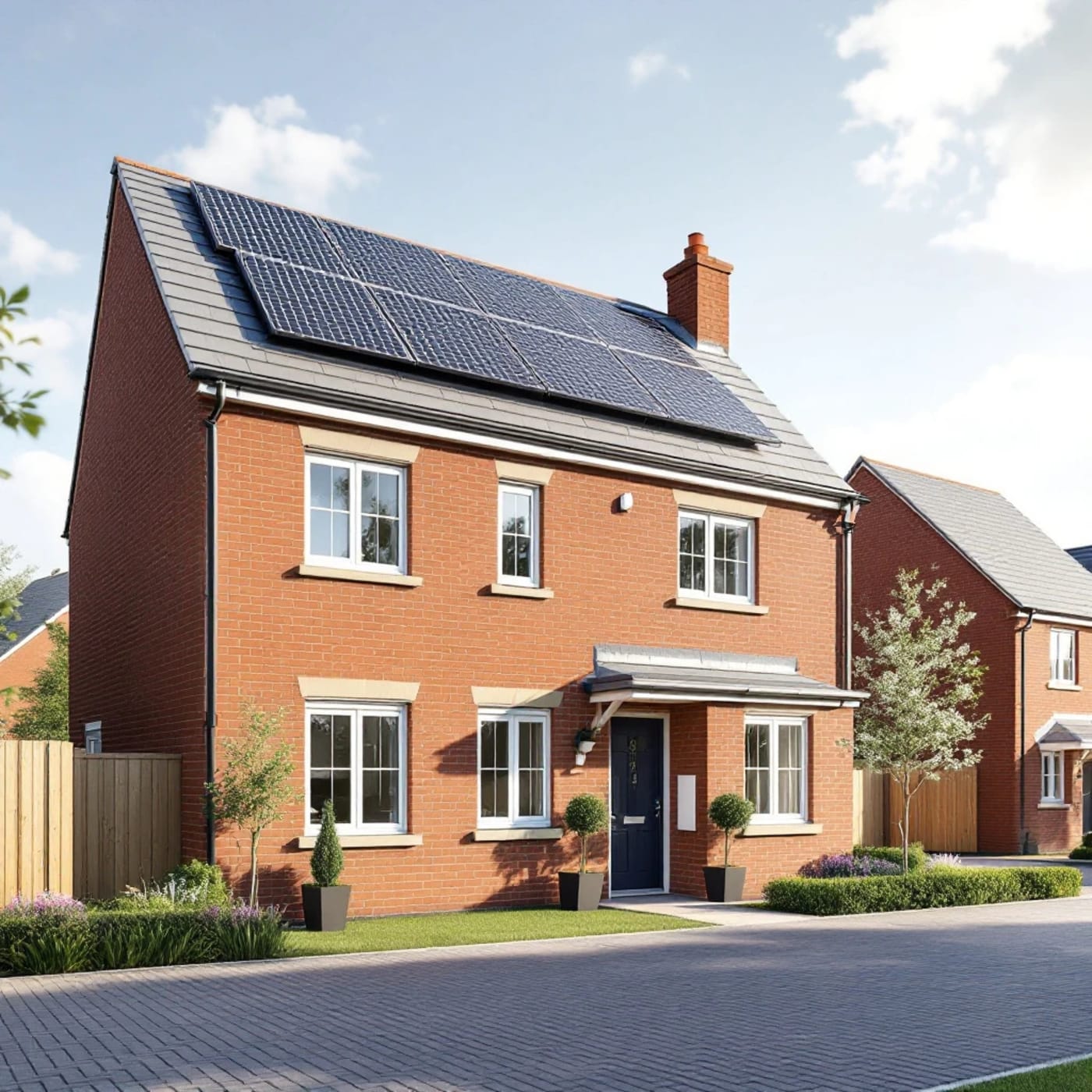
Your new build has solar. Here's how to get the most from it.
Solar panels, battery storage, MCS certification and export payments — explained for new build owners
Solar panels are becoming standard on new build homes, but most owners get far less from them than they could. The panels work well. The problem is when they work: generation peaks in the middle of the day, when many homes are empty, and anything you don't use is exported for a fraction of what you pay to buy electricity back in the evening.
These guides cover how solar actually behaves in a new build, what your developer fits and why, when a battery earns its keep (and when it doesn't), and the paperwork that decides whether you get paid for exports at all — MCS certification and the right meter. Figures were checked in September 2026 and are dated where they change.
Electricity & Battery Calculator
Estimate your annual electricity use, running cost and what a home battery on an off-peak tariff could save.
Read guide →How Solar Works on a New Build
Your panels power the house first. The catch is timing — they peak at midday, when most homes are empty.
Read guide →What You Get With New Build Solar
What developers fit, why it is sized the way it is, and what to ask before you reserve.
Read guide →How Much Does a Battery Save?
The two ways a battery saves money, and why your tariff decides most of the answer.
Read guide →Battery Storage: Pros and Cons
Cost, the 0% VAT deadline, export tariffs, space and siting — and when it is a weak case.
Read guide →Should You Add More Panels?
More panels always earn a little more. Whether they are worth it depends on your export rate, your roof and the grid limit.
Read guide →MCS Certification Explained
Developer-fitted solar is not automatically MCS certified. Without it, you cannot get export payments.
Read guide →Import and Export Meters Explained
What each meter does, what your smart meter must record, and what to check on move-in day.
Read guide →Do new build homes come with solar panels?
Many new build homes already come with solar panels, and new homes in England will legally have to include on-site renewable electricity generation, which in practice means rooftop solar panels, under Future Homes Standard regulations that come into force on 24 March 2027.
The requirement is not in force yet. It will come from the Building Regulations etc. (Amendment) (England) Regulations 2026, published on 24 March 2026, which take effect on 24 March 2027. From then, Approved Document L 2026 sets the benchmark: panels rated at 0.22kWp per m² over an area equal to 40% of the home's ground floor area, or a reasonable output where the roof cannot take that much.
Today, solar is common rather than mandatory. The 2021 energy rules made it one of the main ways for developers to meet their carbon targets. Homes whose building regulations application went in before 24 March 2027 can still be built under those older rules, provided construction starts before 24 March 2028 — so a home completing in 2027 or 2028 may well have been built under the old rules. These rules apply to England; Scotland and Wales set their own.
Why do new build owners get less from their solar panels than they could?
Most new build owners get less from their solar panels than they could because the panels generate most around midday, when the house is often empty, so much of the electricity is exported cheaply instead of being used in the home.
From 1 October to 31 December 2026, the Ofgem price cap on electricity is 26.32p per kWh, a rate that reflects VAT being removed from household electricity until 31 March 2027. Ofgem announces the next cap, for January to March 2027, on 25 November 2026. The Outgoing Octopus export tariff was paying 12p per kWh in September 2026, and some large suppliers' basic export tariffs paid 3p to 6p per kWh (Sunsave comparison, updated 26 August 2026). Every unit you export instead of using is worth less than half of what it costs to buy back.
The fix is rarely more panels. It is using more of what you already generate — by shifting when you run appliances, adding a battery, or choosing a tariff that rewards both.
Do I need a battery with new build solar panels?
You do not need a battery for solar panels to work, but a battery lets you use more of your own solar electricity and, on a time-of-use tariff, charge from the grid at cheap overnight rates to cover the evening peak.
Whether it pays depends mostly on your tariff. On a standard variable tariff with one flat price, a battery only saves by storing your own surplus solar. On a time-of-use tariff, it saves all year, including in winter when panels produce little. Our battery savings guide works through the numbers.
What do I need to get paid for exporting solar electricity?
To get paid for exported solar electricity under the Smart Export Guarantee, you need an MCS certificate (or an accredited equivalent) for your installation and a meter that records half-hourly export readings, which in practice means a smart meter.
This is where new build owners get caught out. If the panels were connected by the developer's electrical contractor rather than an MCS-certified installer, there may be no certificate at all. Read MCS certification explained before you sign up for an export tariff.
Driving electric too? Home charging pairs well with solar and a time-of-use tariff: EV charger installation guides →