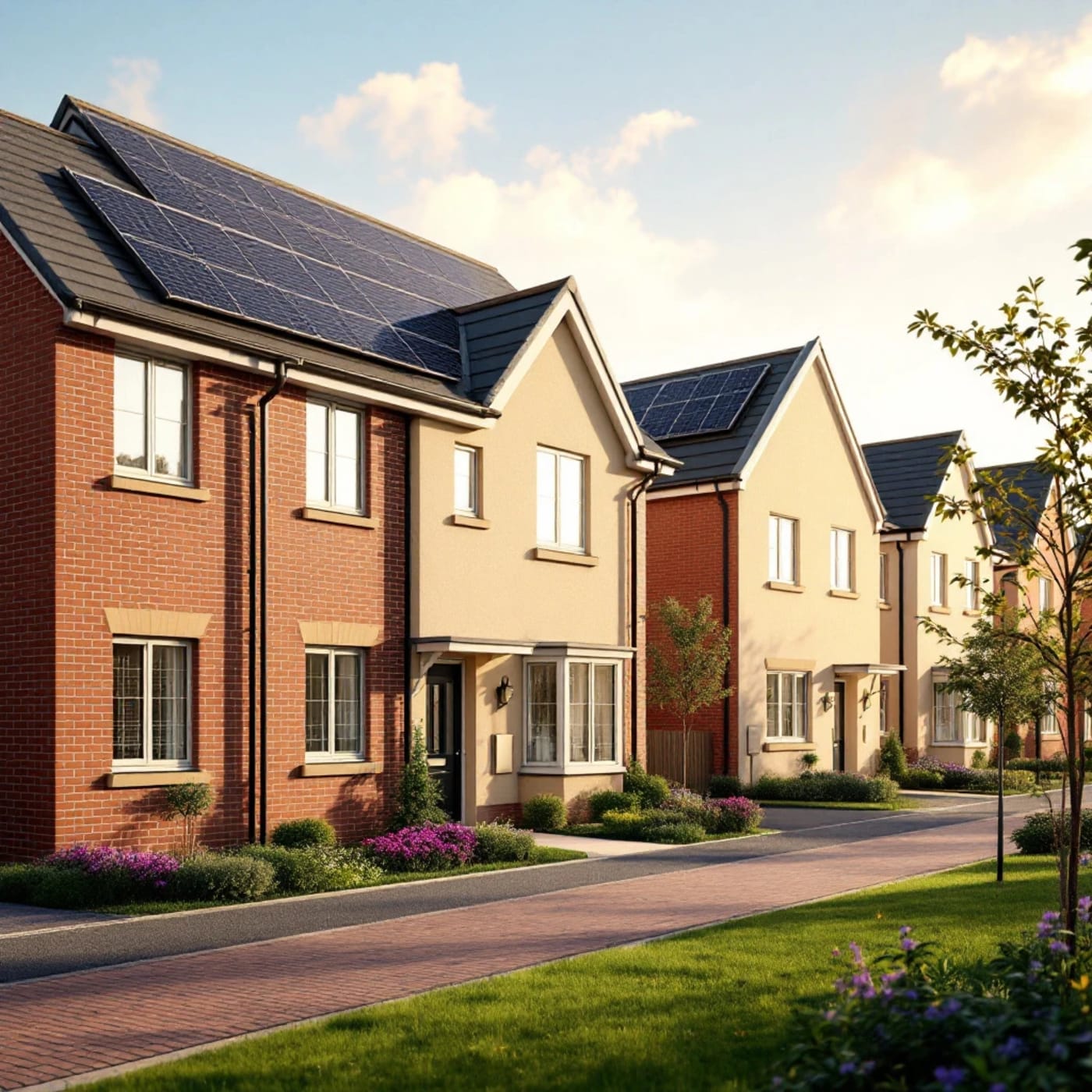
What Solar Do You Actually Get With a New Build?
What developers fit, why it's sized the way it is, and what to ask before you reserve.
5 min readWhat solar system does a developer fit on a new build?
A developer usually fits a roof-mounted solar panel array with an inverter, sized to meet the Building Regulations for that house type rather than to match how much electricity your household will use.
Panels may sit on top of the roof tiles (on-roof) or replace a section of tiles so they sit flush (in-roof). The inverter, which converts the panels' output into usable household electricity, is typically in the loft or garage.
Solar is common on new builds today rather than legally required: developers fit it because it helps homes meet the 2021 energy rules, and the requirement for on-site renewable generation only takes effect on 24 March 2027. A battery is not required under either set of rules. Approved Document L 2026 covers how batteries should be commissioned if one is fitted, but does not require one, so a battery is normally an optional extra or something you add later.
How big is the solar system on a new build?
For new houses in England built under the rules that take effect on 24 March 2027, the Approved Document L 2026 benchmark is solar panels rated at 0.22kWp per square metre covering an area equal to 40% of the home’s ground floor area; homes built under the 2021 rules have no set size.
That benchmark is in paragraph 5.73 of Approved Document L, Volume 1, 2026 edition. It assumes panels facing between south-east and south-west, at a 45° pitch, with no overshading. Worked examples:
- 42m² ground floor (typical three-bedroom semi): 16.8m² of panels → 3.7kWp
- 60m² ground floor (typical four-bedroom detached): 24m² of panels → 5.3kWp
- 80m² bungalow: 32m² of panels → 7.0kWp
Because the benchmark follows ground floor area, not bedrooms or occupants, a large family in a tall, narrow townhouse can end up with a smaller system than a couple in a bungalow. Ground floor area is measured to the internal face of the external walls.
What does the Future Homes Standard require for solar panels?
The Future Homes Standard will require new homes in England to have an on-site renewable electricity generation system capable of a reasonable output, which in practice means rooftop solar panels, but only for building work under regulations that come into force on 24 March 2027 — it is not law yet.
The legal requirement will be a new requirement L3, created by the Building Regulations etc. (Amendment) (England) Regulations 2026, published on 24 March 2026. Approved Document L 2026 explains what a reasonable output is:
- Meet the 40% of ground floor area benchmark, or cover the reasonably practicable roof area.
- Where that is not possible, maximise output with higher-performance panels, different orientations or design changes.
- Only where the roof cannot fit panels generating 720kWh a year can a house go without.
Transition: homes whose building regulations application went in before 24 March 2027 can be built under the previous rules if work starts before 24 March 2028. A home completing in 2027 or 2028 may well have been built under the old rules, so ask which edition of Part L applies to your plot.
Developers must also give you information about on-site electricity generation systems in a Home User Guide at handover.
What is included with new build solar, and what costs extra?
The solar panels, inverter and wiring fitted to meet the Building Regulations are included in the price of the home, while anything beyond that minimum, such as a battery or extra panels, is an optional extra or a later upgrade.
Developers handle extras differently. Some offer a battery or larger system as a paid upgrade that must be chosen before a build-stage cut-off. Others offer nothing and leave it to you after completion.
If an upgrade is offered, get the price in writing and compare it with independent quotes. Our battery pros and cons guide covers retrofit costs and the VAT deadline.
What should I ask the sales advisor about solar before reserving?
Before reserving, ask the sales advisor for the solar system size in kWp, which way the panels face, who will install and commission them, and whether you will receive an MCS certificate at completion.
Then ask:
- Is the plot being built under the 2021 or the 2026 edition of Part L?
- What make and model is the inverter, and is it battery-ready (a hybrid inverter)?
- What warranties come with the panels and the inverter, and who holds them?
- Will a smart meter be fitted that can record half-hourly export readings?
- Can a battery or extra panels be added as an upgrade, at what price, and by what date?
- Will the Home User Guide explain how the system works?
The MCS question matters most. Without an MCS certificate you cannot be paid for exported electricity. See MCS certification explained.
Want more from your new build solar?
Post a job for free and get quotes from local solar installers for extra panels, system checks and upgrades.
Post a Job — Free