Does Your New Build Already Have an EV Chargepoint?
Most new homes in England built since June 2022 aren't starting from nothing. Here's how to tell what you have.
6 min readShould my new build already have an EV chargepoint?
If your home is in England, has parking within its site boundary, and was built under Part S of the Building Regulations, which took effect on 15 June 2022, it should have been built with an EV chargepoint — or, where a chargepoint wasn't required, a cable route ready for one.
This applies to houses as well as flats. For a house, a parking space counts if it is within the home's site boundary — a driveway, or a garage or carport for the home's own use. A space across a public road, or on land belonging to a neighbour, does not count.
For blocks of flats, the number of spaces with a chargepoint must be at least the number of spaces or the number of dwellings, whichever is lower. Spaces in a shared covered car park, and spaces beyond what a £3,600 average grid connection cost allows, get cable routes instead.
Part S applies in England only. Scotland, Wales and Northern Ireland set their own building rules.
How can I tell whether I have a chargepoint or only a cable route?
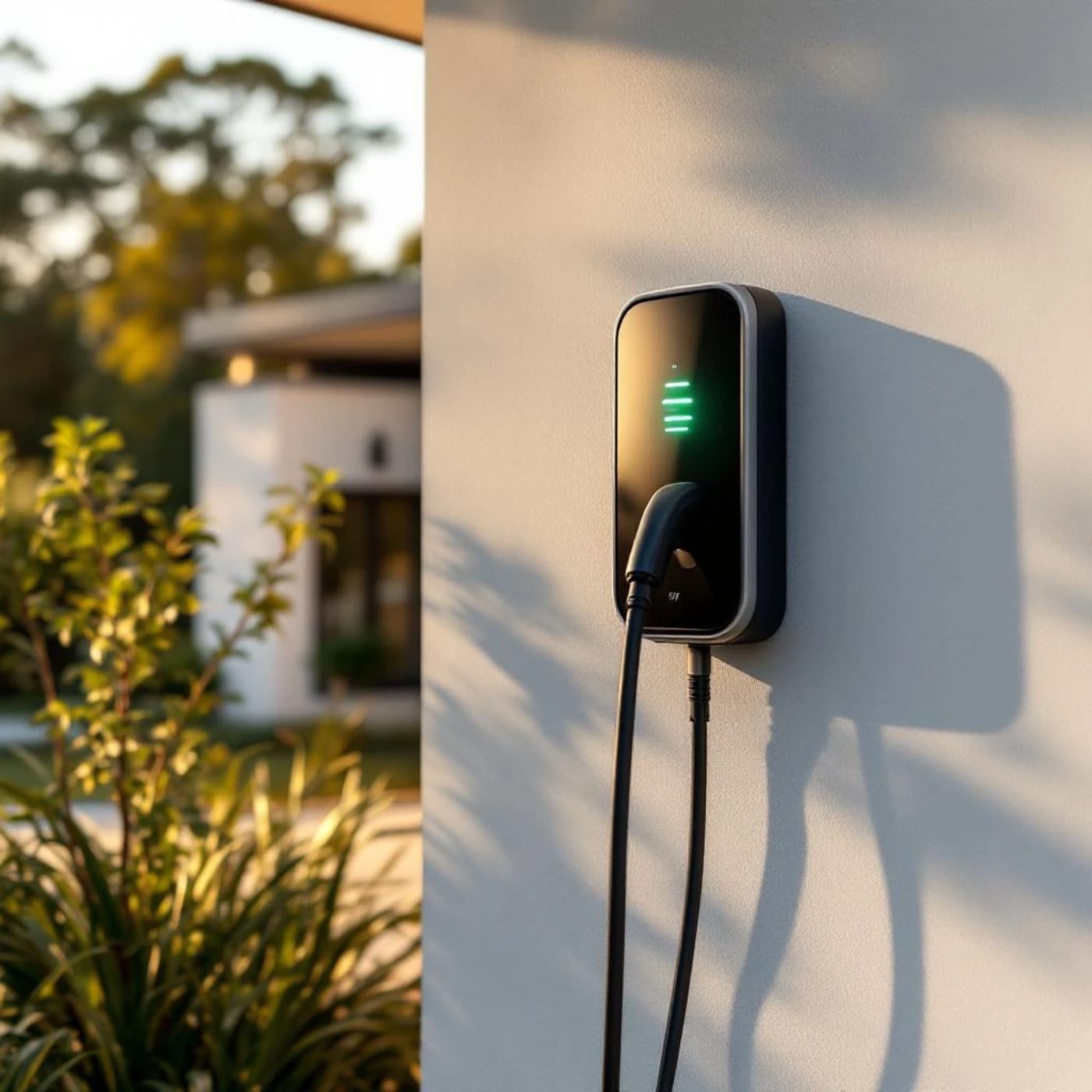
A chargepoint is a wall- or post-mounted charging unit with a socket or cable and a light or display showing its charging status; a cable route has no charging unit at all, and its future connection position should carry a sign reading "Dedicated position for electric vehicle charge point".
Approved Document S sets out what each should look like:
- Chargepoint: at least 7kW, on its own dedicated circuit, with a charging-status indicator. It should normally have a universal socket (untethered); a tethered cable is acceptable only in exceptional circumstances, such as a self-build where the car is already known.
- Cable route: a safe, unobstructed route — such as ducting with a draw rope, trunking or conduit — from a metered supply point to the future connection location, with space at the consumer unit or feeder pillar for a new connection. The sign should measure 506mm by 194mm, with the text over three lines.
A cable route does not have to include the electrical cable itself. Approved Document S lists cabling, upgrades to electrical infrastructure, plinths and vehicle barriers as items that may still be needed to fit a chargepoint later.
What should my completion pack include about EV charging?
Ask your developer for the electrical installation certificate for your home, which Approved Document P says should describe the installation, and the Building Regulations completion certificate — and if a chargepoint was fitted, its make, model and manual.
We could not find a Part S requirement for a specific EV charging handover document, so what developers include varies. If your pack doesn't make it clear whether you have a chargepoint, a cable route or neither, ask the developer in writing. Knowing which you have tells an installer what work is left to do.
What does it cost to fit a charger where a cable route already exists?
We couldn't find a reliable published price for connecting a charger to an existing Part S cable route, so we don't quote one — the saving compared with a full install depends on how much of the job the developer's cable route has already done.
What drives the cost:
- Whether cable is already in the route. Approved Document S requires the route, not the cable. If the duct is empty, the installer still pulls cable through it.
- The consumer unit end. The route should leave space for a new connection, but the installer still needs to fit the circuit and its protection.
- Supply and earthing. Upgrades to electrical infrastructure are outside the cable route standard, and the installer has to confirm how the charger will be earthed.
- The charger itself. See our charger comparison.
Ask installers to quote specifically for connecting to your existing cable route, and tell them what the label and completion pack show. Compare those quotes against a full installation.
My developer fitted a basic charger. Can I replace it with a smarter one?
Yes — but check first whether you need to, because charge points sold for home use in England, Scotland and Wales since 30 June 2022 must by law have smart functionality, so a charger fitted under Part S may already support smart charging and off-peak scheduling.
If you still want to replace it, an electrician removes the old unit and fits the new one. Approved Document P lists installing a new circuit, replacing a consumer unit, and additions or alterations to circuits in special locations as notifiable work. A like-for-like swap on the existing circuit is not on that list, but it must still meet BS 7671, and any new circuit or consumer unit work makes it notifiable.
We couldn't find reliable published prices for swapping an existing charger, so we don't quote one. The main costs are the new charger and whether the existing circuit and protection suit it.
Does replacing it affect anything?
- Your new home warranty. NHBC's Buildmark policy for homes registered from 1 August 2023 excludes anything done to the home after completion and work by anyone other than the builder. So the new charger, its installation and anything they cause are not covered. See how installation affects your warranty.
- The standard it was built to. We couldn't find guidance on whether a replacement must meet Part S. Choosing one that meets the same standards — at least 7kW, a charging-status indicator, a dedicated circuit — avoids the question.
- The old charger's warranty. If you are replacing it because of a fault, check its manufacturer's warranty terms first — some, such as Pod's, are void if you arrange your own installer to carry out a repair.
My new build has parking but no chargepoint and no cable route. Why?
The most likely lawful explanations are that the home was built under the transitional exemption, or that the parking is not within the building's site boundary — a covered car park or the £3,600 cap explain a missing chargepoint, but in those cases there should still be a cable route.
- Transitional exemption. Part S does not apply where the building notice, initial notice or full plans went to building control before 15 June 2022 and work started before 15 June 2023.
- Parking outside the site boundary. Only parking within the building's site boundary counts as associated parking.
- A garage you can't park in. Approved Document S notes that some garages do not contain parking spaces — for example, if a car cannot reasonably be expected to fit.
- Covered car park or the £3,600 cap. These replace chargepoints with cable routes; they don't remove the requirement altogether. The cap has to be evidenced to building control with at least two formal quotes, one from the distribution network operator.
- Not in England. Part S doesn't apply in Scotland, Wales or Northern Ireland.
What can I do if my new build should have had a chargepoint or cable route?
Ask your developer in writing whether Part S applied to your home and why no chargepoint or cable route was provided, and if it should have been, report it to the builder within the two-year builder warranty period.
Your local authority building control, or the private building control body that signed off the home, can tell you when the building notice or full plans were submitted. Under NHBC's Buildmark policy for homes registered from 1 August 2023, the builder must put right anything not built to NHBC requirements during the first two years — and those requirements include complying with all relevant Building Regulations. If your warranty is with another provider, check its policy.
If Part S genuinely didn't apply, you are starting from scratch and our full installation cost guide applies.
Get your EV charger installed and certified
Post a job for free and get quotes from local EV charger installers. Ask how the work will be certified under Part P of the Building Regulations.
Post a Job — Free