
Paintwork snags
The category that fills more lines on a snag list than any other — and the one that pays off most from a slow, careful look.
What to check
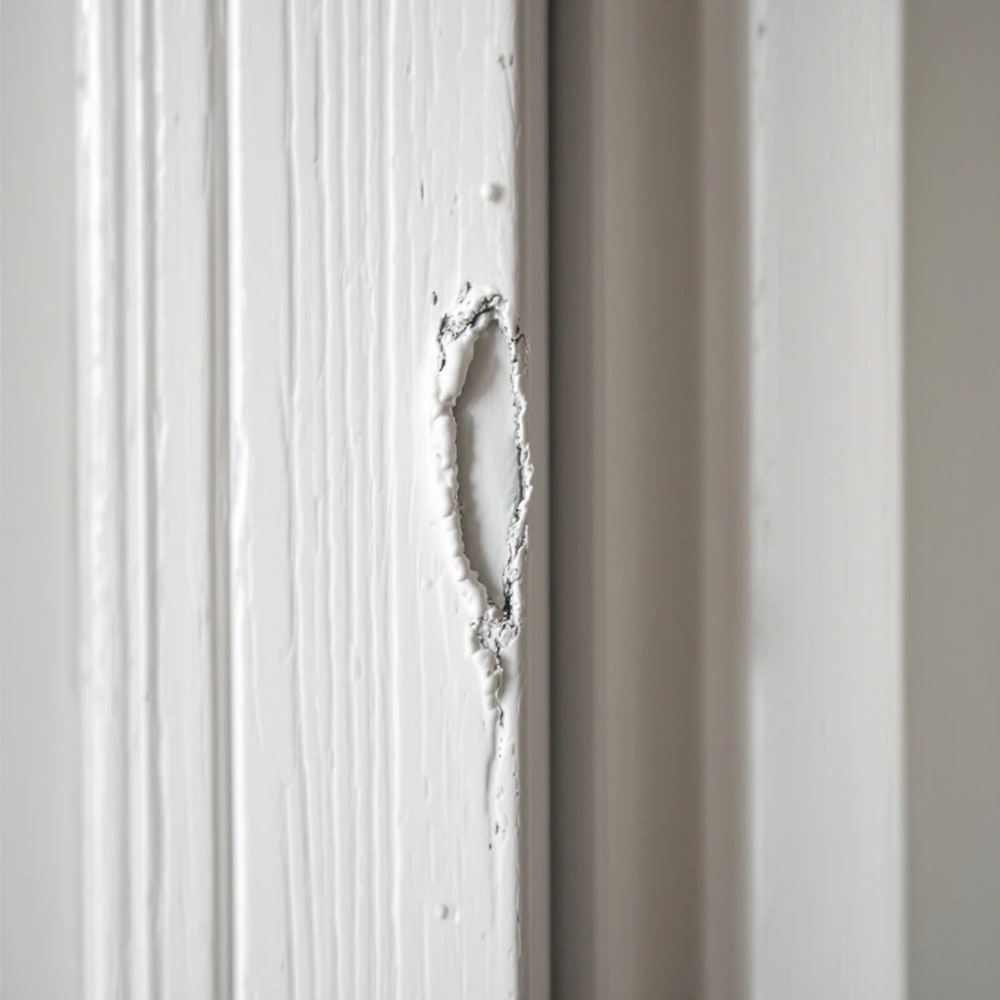
- Chips and knocksLook on door frames, skirting boards, corners and stair spindles where furniture and feet catch.
- Uneven coveragePatches where the wall colour shows through, edges that thin out, roller lines visible in low light.
- Brush marks and dripsCutting-in marks at the ceiling line, drips down skirtings and architraves, runs on doors.
- Splashes on woodworkWall-paint splashes on white woodwork — door frames, skirting, window boards. Easy to miss in direct light.
- Missed spotsTops of doors, behind radiators, inside cupboards, the side of architraves. Common painter oversights.
What’s normal vs. what’s a snag
See the full explanation of NHBC viewing distances, allowed tolerances and where to push back in our pillar guide: What “within tolerance” really means →
What’s normal paintwork — and what you should refuse
Here’s the thing most new-build owners don’t know: your walls have almost certainly only had a mist coat plus one or two top coats of contract emulsion. A mist coat is watered-down emulsion sprayed or rolled onto fresh plaster so it doesn’t peel — it’s a primer, not a finish. Contract emulsion is cheap, chalky, and not wipeable. That’s not a snag; it’s how every volume builder in the UK finishes a house. If you wipe a scuff off the wall and the paint comes with it, that’s the spec, not a defect. Plan to redecorate properly within the first year or two — most owners do.
Screw pops are normal too. Those small circular bumps or dimples appearing on walls and ceilings in the first year are plasterboard fixings showing through as the timber dries and shrinks. Every new build gets them. They’re cosmetic, they’re expected, and they’re dealt with at your end-of-defects inspection — not one by one as they appear.
Shrinkage cracks: the coin rule. Hairline cracks around door frames, ceilings and corners are the house drying out — a new build loses thousands of litres of moisture in its first year. The test: if you can’t fit the edge of a £1 coin into the crack, it’s normal shrinkage and it’s yours to caulk and paint at redecoration. On the staircase, the threshold is a £2 coin — stairs settle and drop slightly over time under the constant weight of people going up and down, so a bigger gap along the string and stair walls is normal movement, not a defect.
So what is a snag?
Touch-ups that flash. When paint is dabbed over a mark instead of the wall being re-coated, the patch dries to a different sheen — invisible head-on, obvious the moment light rakes across it. Here’s the insider truth: decorators don’t want to spot-touch. For the sake of an extra twenty minutes, any decent decorator will paint the wall corner to corner precisely to avoid flashing and avoid being called back. So if a touch-up on your wall is flashing under the standard test — natural daylight, 2 metres — you’re not being fussy asking for the full wall: you’re asking for what the decorator would rather do anyway.
Overpainted hinges, sockets and seals. Paint on doorframe hinges, socket faceplates, window gaskets or flooring is careless masking, and no site manager will defend it. Straightforward snag, always fixed.
Misses and grinning. Bare or thin patches where the previous coat (or bare plaster) shows through — usually behind radiators, above door frames, inside cupboards. Visible from 2m in daylight = snag.
Gloss runs and drips on woodwork you can see and feel.
What the site manager won’t volunteer
Every paint snag you report separately costs the builder a full wall. Because decorators paint wall to wall rather than spot-touch, a mark you report this week and another you report next week means the decorator comes back twice — and the builder pays for two complete walls to fix two small marks. That’s why piecemeal reports get slow-walked and batched lists get actioned: one complete room-by-room paint list, submitted in one go, is the cheapest job for the builder and the fastest result for you. Walk every room in daylight, list every mark, submit once.
Two more things worth knowing:
- The decorator is a subcontractor, not builder staff — and that changes everything about timing. Trades manage their own diaries; the site team can’t summon them. So if the painter was in on Tuesday and you find another mark on Wednesday, it won’t get done Thursday — it waits until the decorator is next on site anyway, doing full decorations in other plots. That could be a day away or a fortnight, and nobody at the builder controls it. It’s also why your batched list gets done quickly: touch-ups slot neatly into a day the decorator is already there, while a special trip for one mark simply doesn’t happen.
- Shrinkage and settlement marks that appear through the first year belong on your end-of-defects list (month 22–23), not in a month-two phone call.
Before you repaint: why “wait 12 months” is really about your wallet
You’ll hear the builder say don’t redecorate in the first 12 months. Here’s the honest reason, which isn’t the one people assume: it’s not that painting early damages the house. It’s that the house is still drying out and shrinking — so you paint a wall in month six, and by month nine there’s a shrinkage crack running across the top of your fresh paintwork, and now you’re caulking and repainting a wall you just paid to have done. Waiting a year lets the movement happen in the builder’s paint, not yours — and it means your end-of-defects fixes at month 22–23 go onto walls you haven’t invested in yet.
If you do paint early, one rule: use a breathable emulsion. New plaster is still releasing moisture, and the builder’s paint is breathable precisely to let it out. Seal a drying wall in a standard vinyl and you can trap moisture — peeling, blistering and damp patches that were never the builder’s fault. Ask any decorator you’re considering what they’d use on new-build plaster: anyone who works new builds answers without hesitating, and that’s how you know you’ve found the right trade.
Beyond the fix: builder-spec walls are the floor, not the ceiling.
Tell us what you need — we'll personally match you with a vetted local painter, free.
Get matched with a painter — freeRelated categories
Run a full inspection with David
David is our free AI snagging assistant. He’ll walk you through every room, log each snag with photos, and generate a PDF report you can send to your builder.
Start a Free Snagging Session