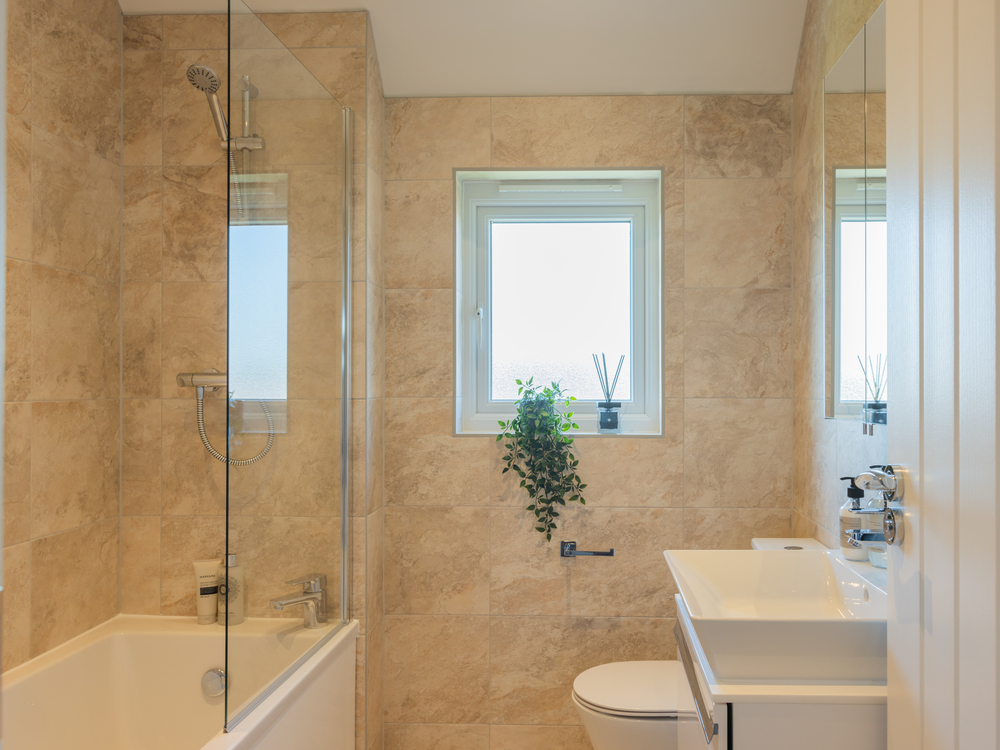
Bathroom snags
The category where unsealed silicone in a wet room means a leak in the lounge below — inspect every seam.
What to check
- Silicone sealsAround the bath, below the shower screen, inside the shower cubicle. Continuous bead, no gaps, no fingerprints in the silicone.
- GroutingTile lines should be clean, full, and the same colour throughout. Missing grout or hairline shrinkage cracks are snags.
- Fixtures and tapsEvery tap runs hot and cold, shuts off fully, doesn't drip. Shower handsets and basin mixers tested separately.
- Shower screen and trayScreen sits square in its channel, tray drains cleanly, the joint to the wall is sealed.
- Extractor fansRun the fan with the light on and off — confirm it actually moves air. A dead extractor is a damp problem later.

What’s normal vs. what’s a snag
See the full explanation of NHBC viewing distances, allowed tolerances and where to push back in our pillar guide: What “within tolerance” really means →
What’s normal in a new-build bathroom — and what you should refuse
Your extractor fan runs 24/7 — and that separate switch isn’t the fan, it’s the boost. This confuses almost everyone: in older houses the fan came on with the light. In a new build, under Part L building regulations, the extractor runs constantly, and the separate switch is a boost mode. The bathroom is where you’re adding the most moisture to a house that’s already drying out — so leave it running, and use the boost, for at least the first twelve months. If you start noticing mould spores around the window sills or along the silicone, that’s your early warning that the room isn’t getting enough air. Don’t scrub it and forget it — ventilate more.
A smell from a bathroom you haven’t used for a few days is normal. The water in the trap dries out and the drain smell creeps through. Run the taps, flush the toilet, smell gone. (A smell in a bathroom you use every day is a different story — see below.)
Low pressure on an electric shower is one of the honest disappointments. If the pressure is just weak, there’s frankly not much the site manager can do about it — that’s the system you’ve bought. Which is exactly why the shower test below matters so much on day one: know what you’ve got before you complete, not after.
So what is a snag?
An electric shower that runs hot and cold. Test your shower thoroughly on day one — run it properly, not a ten-second demo. People constantly have problems with them: temperature cycling hot-cold-hot is a genuine fault, and it goes straight on the snagging list.
Tiles — the finish and the grout. The most constant bathroom complaint there is. Check every tiled face in daylight: chipped tiles, scratched glaze, grout lines that are thin, missing, or smeared.
Silicone that isn’t continuous. Around the sink, around the toilet, around the bath and shower — one unbroken, tidy bead everywhere water meets a joint. Gaps and thin corners are where water gets in.
Taps plumbed wrong. Both hot and cold actually working — and the right way round. You’d be surprised.
The bath test: fill it, and watch the silicone. Here’s one almost nobody knows. When a housebuilder seals a bath, they should fill it with water first — the weight pulls the bath down so the silicone sets in its loaded position. But baths get sealed empty, especially when there’s no water running to the plot on install day. The result: the first few times you fill the bath, the weight drops it, and the silicone cracks along the edge. The test is simple: day one, fill your bath, leave it standing for thirty minutes, and check the silicone doesn’t crack. If it cracks, it was sealed empty — report it, and the fix is a proper re-seal (done filled, this time).
Flooring that isn’t sealed at the edges. Bathrooms get water on the floor — that’s life. If the flooring isn’t sealed properly at the perimeter, water works underneath and blows the floor. Check the edges now, not after the first bathtime flood.
A window unit fitted back-to-front. Sealed glazing units have a right way round — there’s a compliance sticker on each unit that should read from inside the room. On a busy site, units get fitted backwards more often than you’d think (sometimes a whole plot’s worth). Fitted the wrong way, the thermal coating faces the wrong direction — you lose heat-retention performance — and clear panes can act like a mirror at night. Check the bathroom window’s sticker reads from inside before signing anything off.
What the site manager won’t volunteer
Why new-build drains block more than old-house drains. It’s not your fault and it’s usually not fair wear: a live development has rubble, sand and debris moving through it for years, and one exposed manhole upstream is all it takes for material to wash into the runs — including yours. So the diagnostic matters: a smell in an unused bathroom is just a dried trap; a smell in a bathroom you use daily means the drains are likely partly blocked — and blocked-by-site-debris is the builder’s problem, not yours. Expect the first response to be “it’s just a blockage, run some water through” — hold your ground, because drainage is a high-cost item, and high-cost items are exactly the ones that get pushed to customer service and down the line.
The bath was probably sealed empty if the plot had no water on install day. That’s the why behind the fill test above — it’s not carelessness so much as sequencing: baths go in before the plot is commissioned, water isn’t running, so the sealer seals it empty and moves on. The builder knows this happens. The fill test catches it inside your snagging window instead of at month eight.
Keep it right: the insider care tips
- Clean the shower trap monthly. Modern showers use low-level trays with a shallow trap — there’s a little bucket under the cap that catches hair, and it fills faster than you’d think. Because the tray is so low, a slow-draining shower doesn’t take long to overflow. Pop the cap, empty the bucket, once a month.
- Boost is your friend for the first year. The house is drying out and the bathroom is the wettest room in it — run the extractor boost freely and keep the fan on 24/7 for the first twelve months.
The question that vets a bathroom fitter
When you’re getting a bath re-sealed or a bathroom refitted, ask the candidate one question: “When you seal a bath, do you fill it first?” Anyone who knows their trade answers instantly — of course, the bath has to be sealed under load or the silicone cracks the first time it’s filled. A fitter who hesitates, or asks why, has just told you everything you need to know.
Beyond the fix: builder-spec sealing is the minimum, not the standard.
Tell us what you need — we'll personally match you with a vetted local bathroom fitter, free.
Get matched with a bathroom fitter — freeRelated categories
Run a full inspection with David
David is our free AI snagging assistant. He’ll walk you through every room, log each snag with photos, and generate a PDF report you can send to your builder.
Start a Free Snagging Session